
Seen something unusual? MAKE A REPORT
Seen something unusual? MAKE A REPORT

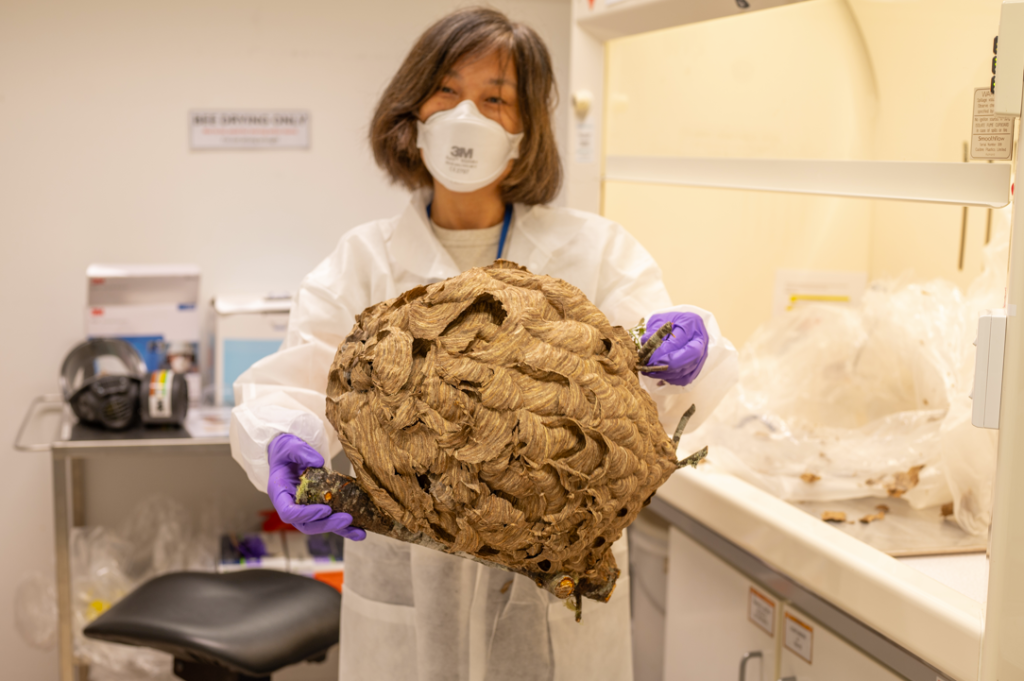
Image: Yan Chen, Biosecurity New Zealand scientist, with a secondary Yellow-legged hornet nest.
Biosecurity New Zealand is deploying a new tool in the fight against the Yellow-legged hornet in Auckland.
The response will soon start using a locally developed protein-based insecticide bait that has proven extremely successful on wasps and is expected to be effective against the hornet.
Targeting hornets with this product, called Vespex, is a world-first, as unlike in other countries, New Zealand has no native wasps that are attracted to this bait, so native species won’t be harmed. Research has also shown that the product does not affect honeybees.
Vespex has low toxicity to mammals and birds, and they would need to consume a large amount of bait to show any symptoms of poisoning. The active ingredient, fipronil, is used in pet flea and tick products in higher concentrations than what will be used in this response.
The bait will be placed in special stations and visiting hornets then roll it into small balls and take it back to the nest where it poisons others.
The stations are set in the response B and C Zones, which are the surveillance areas furthest from where hornets are being detected on Auckland’s North Shore. These outer areas are being targeted first to destroy any hornets that have so far evaded traps or sightings by the public. This gives us an extra layer of insurance.
The response will ultimately use the Vespex in the central A Zone where the hornets are concentrated, but for now there is great success tracking hornets to nests using visual inspections and radio trackers.
In addition, there has been a new breakthrough using drone-based thermal imaging. Using this technology over an area where a suspected nest was present, it has been possible to locate a new secondary nest.
The Yellow-legged hornet response is progressing well, and the end goal remains eradication. Read the latest on our dedicated response web page here.
KVH investigates reports of unusual symptoms to identify and manage any biosecurity risks.
The KVH portal is now the Zespri Weather & Disease Portal. Access all the weather tools you're familiar with.