
Seen something unusual? MAKE A REPORT
Seen something unusual? MAKE A REPORT
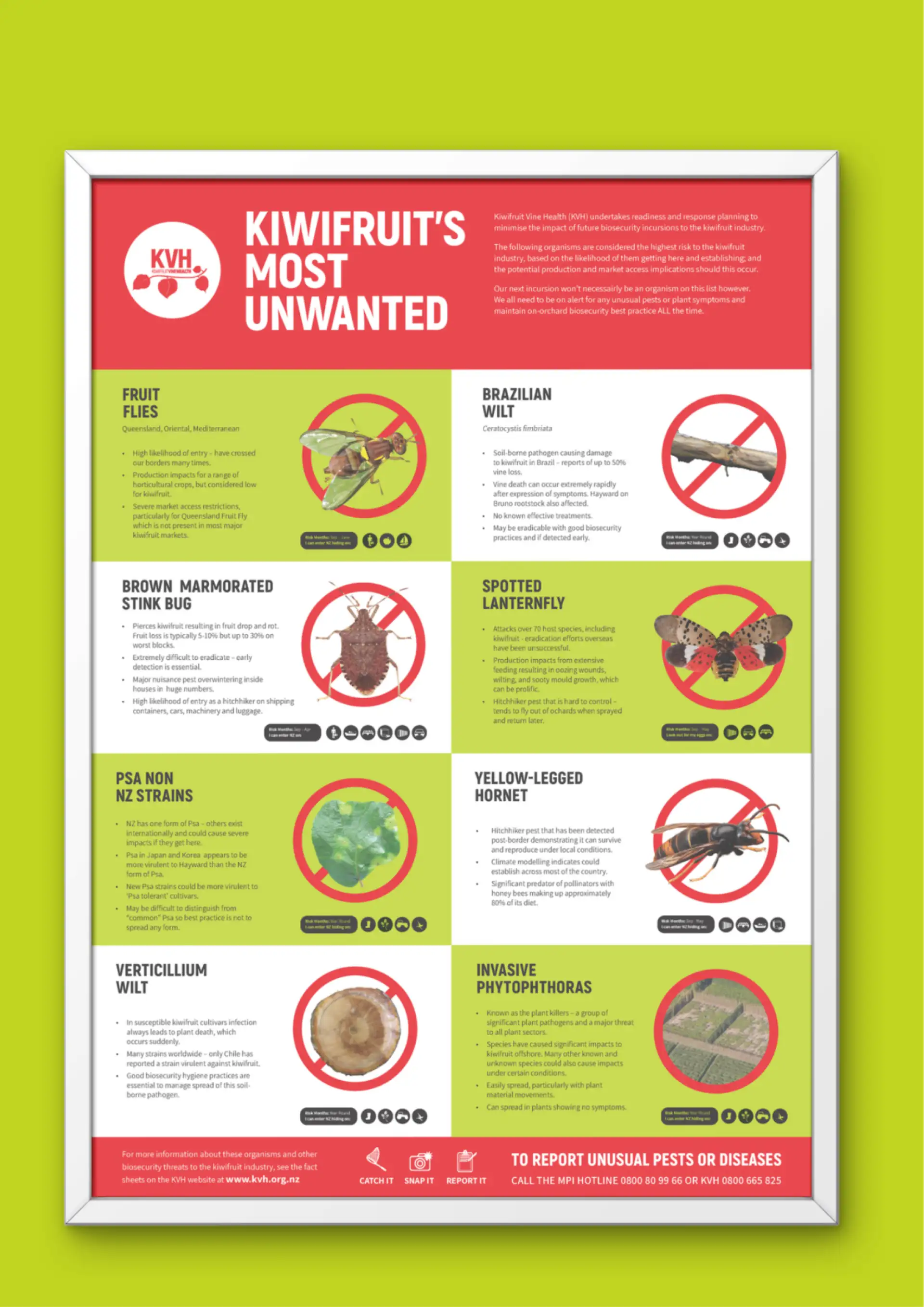
There are eight organisms identified as the biggest biosecurity threat to New Zealand's kiwifruit industry.
09/09/2026
With spring bringing increased biosecurity risk for some of our most unwanted threats, now is the perfect time to make sure pest identification resources are close at hand. KVH's handy pest ID ring cards feature key pests and diseases of biosecurity concern to the kiwifruit industry and are ideal for orchard staff, contractors and visitors. Order your free set today and we'll send them straight out to you, helping everyone on orchard know what to look for and what to report if something unusual is found. Order now and be prepared for the season ahead.
Read more about High-risk season is here – order your pest ID ring cards now09/09/2026
A group of USA lawmakers is pushing for the Spotted Lanternfly (SLF) to be officially recognised as an invasive species, highlighting the significant risk it poses to the country’s agricultural sector. The proposed legislation identifies SLF as a priority biosecurity issue and calls for increased investment in research and management to support long-term control and mitigation. The move reflects growing concern about the pest's impact on agriculture, particularly vineyards. In New York alone, the grape industry could lose more than US$14 million within the first three years of an infestation if the pest isn't effectively controlled. For New Zealand kiwifruit growers, it's a timely reminder of why SLF remains on KVH's Kiwifruit's Most Unwanted list. While it is not present here, its rapid spread and economic impacts overseas highlight the importance of keeping it out. The threat continues to grow internationally, with the first European detection recently reported in Moldova. Although the initial infestation was thought to have been eradicated, isolated populations were later found outside the original area. The increasing political attention and investment in managing SLF overseas reinforces an important biosecurity message: preventing high-risk pests from entering New Zealand is far more effective and affordable than managing them once established.
Read more about USA steps up fight against Spotted Lanternfly09/09/2026
Image: James Blair, 2026 Young Grower of the Year, during his biosecurity module at the national competition in Cromwell. This year, KVH continued its support of horticulture’s emerging leaders by becoming a silver sponsor of the Young Grower of the Year national final in Cromwell, delivering a biosecurity module at the event. Despite heavy rain on the day, the weather did little to dampen the enthusiasm of the competitors. Regional finalists put their practical skills and knowledge to the test across a broad range of horticultural topics. The KVH module challenged competitors to demonstrate their understanding of how the multiple layers of New Zealand’s biosecurity system work together to protect our primary industries. They were also tested on their ability to recognise key pests and biosecurity risks in the workplace and to apply practical biosecurity measures relevant to their own sites and industries. Hands-on activities covering tool hygiene and pest reporting added an interactive element to the module. Competitors brought plenty of energy, enthusiasm, and lateral thinking to the challenges and KVH congratulates them all on their skills, commitment, and dedication to building careers that will contribute to the future of New Zealand’s growing industries and communities. Congratulations to James Blair, an agronomist with AS Wilcox, who was named the 2026 Young Grower of the Year. Amber Davy, Quality and Field Manager for seed potato supplier Eurogrow and the Canterbury finalist, was runner-up with Amelia Marsden, Nursery Manager at Thomas Brothers Orchard and Nelson regional finalist, placing third. Finalist profiles and competition highlights can be found here.
Read more about Young growers put biosecurity skills to the test09/09/2026
Image: Biosecurity Business Pledge members touring Queenstown Airport. KVH recently attended the Biosecurity Business Pledge forum in Queenstown, joining government, businesses, community groups and individuals working together to strengthen biosecurity resilience across the region. The day began with a behind-the-scenes tour of Queenstown Airport’s biosecurity operations, including detector dogs and passenger and baggage screening. With around 17 international flights arriving daily from Australia, Queenstown is an important pathway for the movement of people and goods into New Zealand. Maintaining strong biosecurity at these entry points is critical to protecting primary industries. The group also visited areas where wilding pine control and restoration work is underway. Community and commercial efforts are helping remove invasive wilding pines across Queenstown and the Wakatipu Basin, alongside projects aimed at restoring native biodiversity. Central Government funding is also supporting work in this high priority landscape. Over lunch Stuart Anderson, Deputy Director-General at Biosecurity New Zealand, provided a behind-the-scenes insight into New Zealand's frontline biosecurity system. A panel discussion involving local airport and wine industry representatives highlighted an important message: effective biosecurity depends on everyone playing their part. Everyday movements of people, plants, animals and equipment can provide pathways for pest and disease spread, so simple actions and good systems can make a real difference.
Read more about Biosecurity in action - Queenstown lessons24/08/2026
Hot off the press at the AGM were printed copies of our new Annual Report. Please email us if you would like a copy sent to you. The booklet details our key activities and achievements over the last 12 months, a year where preparedness was put to the test, and responses were in action. Read the 2025/26 report
Read more about Annual Report available now27/08/2026
Pollination is one of the most important activities in the orchard calendar. Many kiwifruit orchards rely on artificial pollination, as well as pollination by bees, to ensure effective pollination takes place. The movement of pollen and flowers between orchards and regions must be managed to minimise the risk of disease spread and movement to orchards where Psa is not detected, and to the South Island, is strictly prohibited or restricted. All pollen providers and distributors of pollen are required to register with KVH, and growers should only be sourcing pollen from these registered providers. All kiwifruit pollen operators - defined as "every person or entity collecting, milling, selling, distributing and/or artificially applying pollen"- must register with KVH annually via the KVH website. This includes all pollen mill operators (including growers who mill for their own use) and anyone who has sourced pollen from a mill for further distribution. More information is available on the KVH website here.
Read more about Pollen providers and distributors to register with KVH24/08/2026
KVH is proud to be a sponsor of the Young Grower of the Year National Final, supporting the next generation of horticultural leaders. As part of the competition (taking place in Cromwell), KVH is hosting a biosecurity module, challenging finalists to apply their knowledge and decision-making skills to real-world biosecurity scenarios. The grand final takes place tomorrow, with the country’s top young growers taking the stage one final time to compete in the speech module, before the 2026 title winner is announced. Biosecurity is everyone’s responsibility, and it’s encouraging to see the calibre of young growers stepping up. We’ll have more about the biosecurity module in the next Bulletin. Meet the finalists
Read more about Biosecurity at national young grower competition21/08/2026
The KVH Annual General Meeting (AGM) took place Thursday, 20 August. We extend our thanks to everyone who attended and participated in the voting process. All resolutions presented at the meeting were approved and are listed below. As Simon Cook is retiring from the KVH Board there was a vacancy and we extend our congratulations to David Tanner on his successful election as Grower Director. Resolutions passed The minutes from the 2025 AGM received approval. Both the Chair and Chief Executive’s reports were accepted. The performance report for 2025/26 was approved. Levy rates for the Biosecurity (Readiness and Response) and the Biosecurity (Kiwifruit National Pathway Management Plan) were confirmed. The budget for 2027/28 was approved. Directors’ fees will increase by 2.9% for the 2026/27 financial year and a new allowance for the Audit and Risk Management Committee Chair was approved. BDO has been reappointed as auditor for the 2026/27 financial year. David Tanner was elected as Grower Director for a three-year term. If you have questions regarding the AGM results, please contact us or speak with a KVH Director.
Read more about 2026 AGM results10/08/2026
Around 100 growers, post-harvest representatives, researchers, government partners and biosecurity professionals came together at Bay Oval last week for the 2026 KVH Biosecurity Symposium, united by a shared goal of keeping the New Zealand kiwifruit industry prepared for future biosecurity threats. Held every two years, this year's event focused on the theme Staying ahead of the invasion curve, highlighting the importance of proactive readiness, rapid response and strong collaboration across the industry and our biosecurity system. The programme featured a strong line-up of New Zealand and Australian guest experts sharing lessons from real-world incursions, emerging threats, surveillance programmes, research initiatives and response experiences. Highlights included John Kean from the Bioeconomy Science Institute (BSI) and Andrew Robinson from the Centre of Excellence for Biosecurity Risk Analysis (CEBRA) in Melbourne presenting a new science-based approach to optimising biosecurity surveillance for the kiwifruit industry, designed to strengthen early detection of exotic pests and diseases. Attendees also heard from Scott Sinclair from Biosecurity New Zealand on yellow-legged hornet detection tools and surveillance operations, Leanne Erakovic from the Australian Banana Growers’ Council on the global challenge of Panama disease TR4 in bananas, Aaron Dodd from the Australian Department of Agriculture, Fisheries and Forestry on their evolving approach to brown marmorated stink bug surveillance, and Dr Jon Sullivan from Lincoln University on lessons learned from 25 years of wild kiwifruit control. Research and innovation were a major focus, with Rebecca Burns outlining Zespri Innovation's approach to building biosecurity readiness across high-risk threats, generic readiness and emerging risks, while Beccy Ganley spoke to research from Better Border Biosecurity and BSI exploring how new technologies and targeted research can help strengthen New Zealand's biosecurity system. Day two saw participants take part in an interactive Fruit Fly Council workshop, testing how the horticulture sector would maintain supply chains during a fruit fly incursion. The exercise explored the impacts of movement controls and export restrictions, while identifying opportunities to further improve preparedness across the industry. Thank you to everyone who attended and contributed to making this year's Symposium such a valuable event. It was a fantastic opportunity to share knowledge, strengthen connections across the biosecurity network, and reinforce the readiness needed to protect New Zealand's kiwifruit industry from exotic threats. A special thank you to our event sponsors, without whom we would not have been able to offer the Symposium. Thank you to Horticentre Charitable Trust; the Bioeconomy Science Institute; Zespri; NZKGI; Onside; Fruitfed Supplies; and the Port of Tauranga for the support and presence throughout the event. See images from the event here and if you'd like a copy of the slides from the day please email us. We’ll also have a more extensive article about the Symposium in the next issue of the Kiwifruit Journal.
Read more about Symposium showcased the best in biosecurity14/08/2026
Exotic fruit flies are one of our industry’s biggest biosecurity threats and kiwifruit growers know better than anyone the threat they pose – as proven by the importance placed on the workshop at the recent Symposium. To help manage this threat, Biosecurity New Zealand undertakes national surveillance for exotic fruit flies. Delivered by AsureQuality for more than 30 years, the programme is designed to detect exotic fruit flies that make it into New Zealand. Detections through this programme have triggered 16 successful biosecurity responses since 1990, stopping unwanted fruit fly species from establishing here. The surveillance programme has operated since the 1970s and currently includes more than 7800 traps nationwide. To strengthen surveillance further, Biosecurity New Zealand plans to expand the network by more than 1100 traps during the 2026-27 high-risk season, bringing the total to around 9000 traps. The additional traps will be focused on areas of urban growth in the upper North Island, where conditions are most suitable for many fruit fly species. New traps will be installed in Auckland, Hamilton, Tauranga and Hawke's Bay. Additional trapping will also be introduced around Hamilton and Dunedin airports following the recent resumption of international flights from Australia. AsureQuality field officers will be identifying new trap locations over the coming weeks. If your property is selected as a potential site, you may be contacted about hosting a trap. If kiwifruit growers are visited by AsureQuality and have any further queries or would like any information or resources from KVH, please don’t hesitate to get in touch for guidance. As always, if you see something suspicious – catch it or photograph it if safe to do so and report it to Biosecurity New Zealand on 0800 809 966 or KVH on 0800 665 825.
Read more about Increase in fruit fly traps10/08/2026
KVH was also pleased to be part of the Tauranga Moana Biosecurity Capital (TMBC) Symposium yesterday, joining industry, iwi, researchers, businesses and community groups to explore how the Bay of Plenty can strengthen its position as New Zealand's biosecurity capital. The event provided an opportunity for KVH to share insights from recent kiwifruit biosecurity responses and readiness activities with peers, while highlighting the importance of collaboration across sectors to protect the region's growers, economy, and environment from harmful pests and diseases. With biosecurity risks continuing to evolve, the Symposium reinforced the key message that strong partnerships and collective action are essential and having networks across the biosecurity space in the region helps keep us abreast of any potential changes to biosecurity risk for kiwifruit growers, as well as allowing us input into wider biosecurity management activities, particularly at higher risk sites like ports and transitional facilities.
Read more about KVH at Tauranga Moana biosecurity event14/08/2026
Biosecurity awareness month is a timely reminder that protecting New Zealand's kiwifruit industry starts with all of us. As a campaign partner, KVH encourages growers to stay alert, follow good biosecurity practices, and report anything unusual, because early detection remains one of our best defences against new threats. The Biosecurity Business Pledge also offers practical resources to help all businesses proactively strengthen their biosecurity practices and preparedness at the most senior level, supporting the protection of orchards, livelihoods, and the industry we all rely on. View the Pledge’s resources
Read more about Keeping biosecurity front of mind for all this August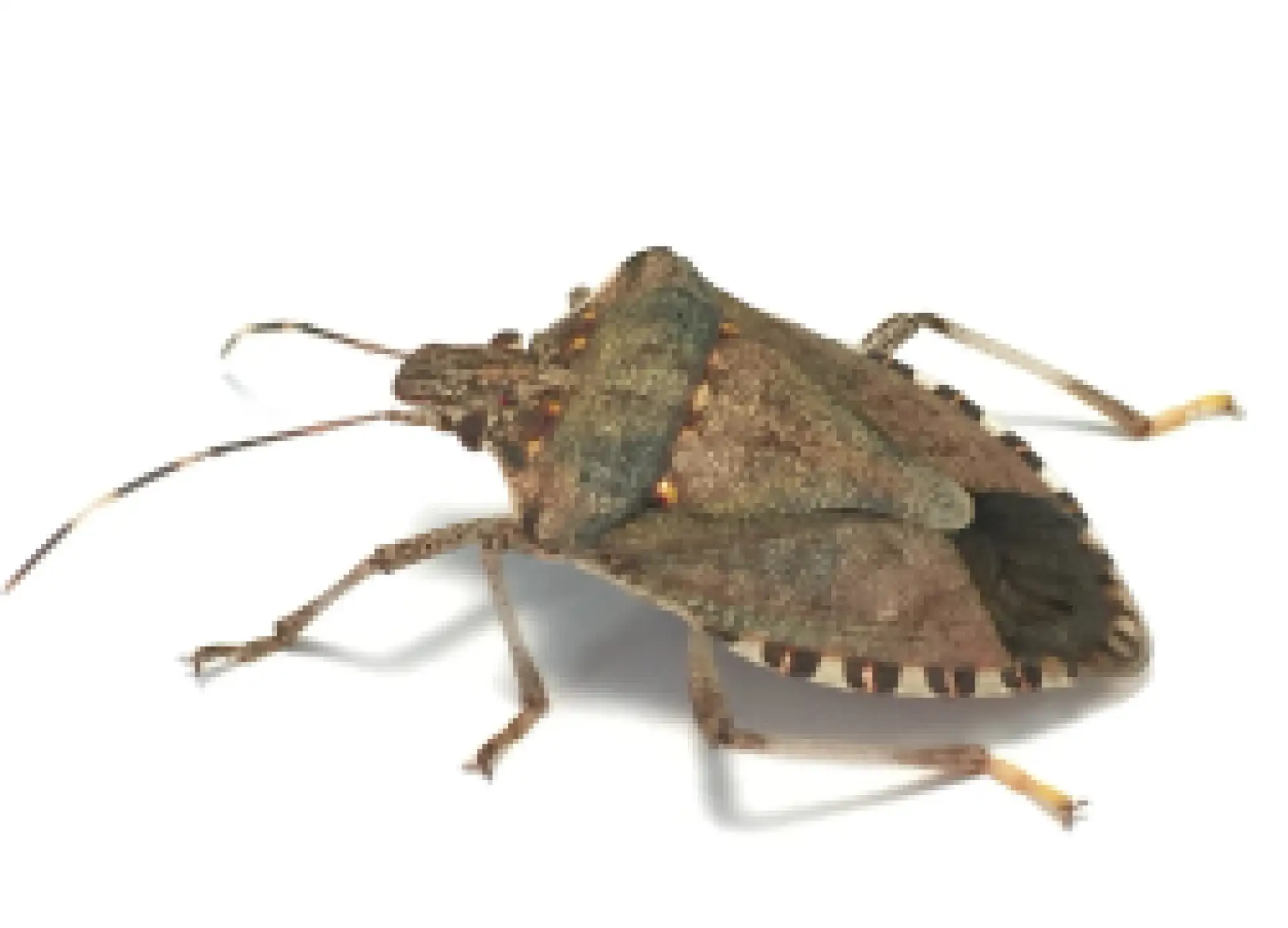
The Brown Marmorated Stink Bug (BMSB) is the kiwifruit industry’s second-most unwanted biosecurity threat after fruit flies; and the risk of it entering New Zealand is considered extreme.
The BMSB is able to hitchhike on inanimate objects such as cars and shipping containers. If it were to enter New Zealand it would have no problem establishing due to New Zealand’s highly suitable climate and abundance of host material. Its entry and establishment would result in significant production impacts to many horticultural industries.
The high risk and potential consequence of BMSB have made it a priority for biosecurity readiness activities for both KVH and the Ministry for Primary Industries (MPI).
Pest ranking based on the KVH risk matrix
View risk matrixBMSB preparedness
KVH is working with Zespri, MPI and the wider kiwifruit industry to ensure we are all prepared for BMSB, if it were to arrive and establish here. This includes running regular simulation exercises, hosting workshops, and developing joint workplans for how we would manage an incursion and long term response.
Read the BMSB Readiness Plan (A) for information about how the industry is ready for a New Zealand incursion. Read the BMSB Readiness Plan (B) for information about long term management considerations should BMSB establish in New Zealand.
Read the BMSB kiwifruit growers guide to long-term management. The guide outlines all the things growers should do on-orchard and how to do them when managing BMSB long-term.
In August 2018 the New Zealand horticulture industry welcomed the Environmental Protection Authority’s (EPA) decision allowing the release of a tiny Samurai Wasp into New Zealand, if ever there was an incursion of the BMSB. Read the media release here.
KVH and Zespri have recently designed a useful infographic tool for growers. It encourages growers to cast their eye into a possible future where BMSB has arrived in New Zealand and all response/eradication efforts have failed. What long-term management of the bug might look like on-orchard; factors to consider into future planning; and the times of the year each is most appropriate, is summarised in the infographic here.
KVH investigates reports of unusual symptoms to identify and manage any biosecurity risks.
09 Sep 2026
With spring bringing increased biosecurity risk for some of our most unwanted threats, now is the perfect time to make sure pest identification resources are close at hand. KVH's handy pest ID ring cards feature key pests and diseases of biosecurity concern to the kiwifruit industry and are ideal for orchard staff, contractors and visitors. Order your free set today and we'll send them straight out to you, helping everyone on orchard know what to look for and what to report if something unusual is found. Order now and be prepared for the season ahead.
Read more about High-risk season is here – order your pest ID ring cards now09 Sep 2026
A group of USA lawmakers is pushing for the Spotted Lanternfly (SLF) to be officially recognised as an invasive species, highlighting the significant risk it poses to the country’s agricultural sector. The proposed legislation identifies SLF as a priority biosecurity issue and calls for increased investment in research and management to support long-term control and mitigation. The move reflects growing concern about the pest's impact on agriculture, particularly vineyards. In New York alone, the grape industry could lose more than US$14 million within the first three years of an infestation if the pest isn't effectively controlled. For New Zealand kiwifruit growers, it's a timely reminder of why SLF remains on KVH's Kiwifruit's Most Unwanted list. While it is not present here, its rapid spread and economic impacts overseas highlight the importance of keeping it out. The threat continues to grow internationally, with the first European detection recently reported in Moldova. Although the initial infestation was thought to have been eradicated, isolated populations were later found outside the original area. The increasing political attention and investment in managing SLF overseas reinforces an important biosecurity message: preventing high-risk pests from entering New Zealand is far more effective and affordable than managing them once established.
Read more about USA steps up fight against Spotted Lanternfly09 Sep 2026
Image: James Blair, 2026 Young Grower of the Year, during his biosecurity module at the national competition in Cromwell. This year, KVH continued its support of horticulture’s emerging leaders by becoming a silver sponsor of the Young Grower of the Year national final in Cromwell, delivering a biosecurity module at the event. Despite heavy rain on the day, the weather did little to dampen the enthusiasm of the competitors. Regional finalists put their practical skills and knowledge to the test across a broad range of horticultural topics. The KVH module challenged competitors to demonstrate their understanding of how the multiple layers of New Zealand’s biosecurity system work together to protect our primary industries. They were also tested on their ability to recognise key pests and biosecurity risks in the workplace and to apply practical biosecurity measures relevant to their own sites and industries. Hands-on activities covering tool hygiene and pest reporting added an interactive element to the module. Competitors brought plenty of energy, enthusiasm, and lateral thinking to the challenges and KVH congratulates them all on their skills, commitment, and dedication to building careers that will contribute to the future of New Zealand’s growing industries and communities. Congratulations to James Blair, an agronomist with AS Wilcox, who was named the 2026 Young Grower of the Year. Amber Davy, Quality and Field Manager for seed potato supplier Eurogrow and the Canterbury finalist, was runner-up with Amelia Marsden, Nursery Manager at Thomas Brothers Orchard and Nelson regional finalist, placing third. Finalist profiles and competition highlights can be found here.
Read more about Young growers put biosecurity skills to the test